And then wondered what went wrong with the rest
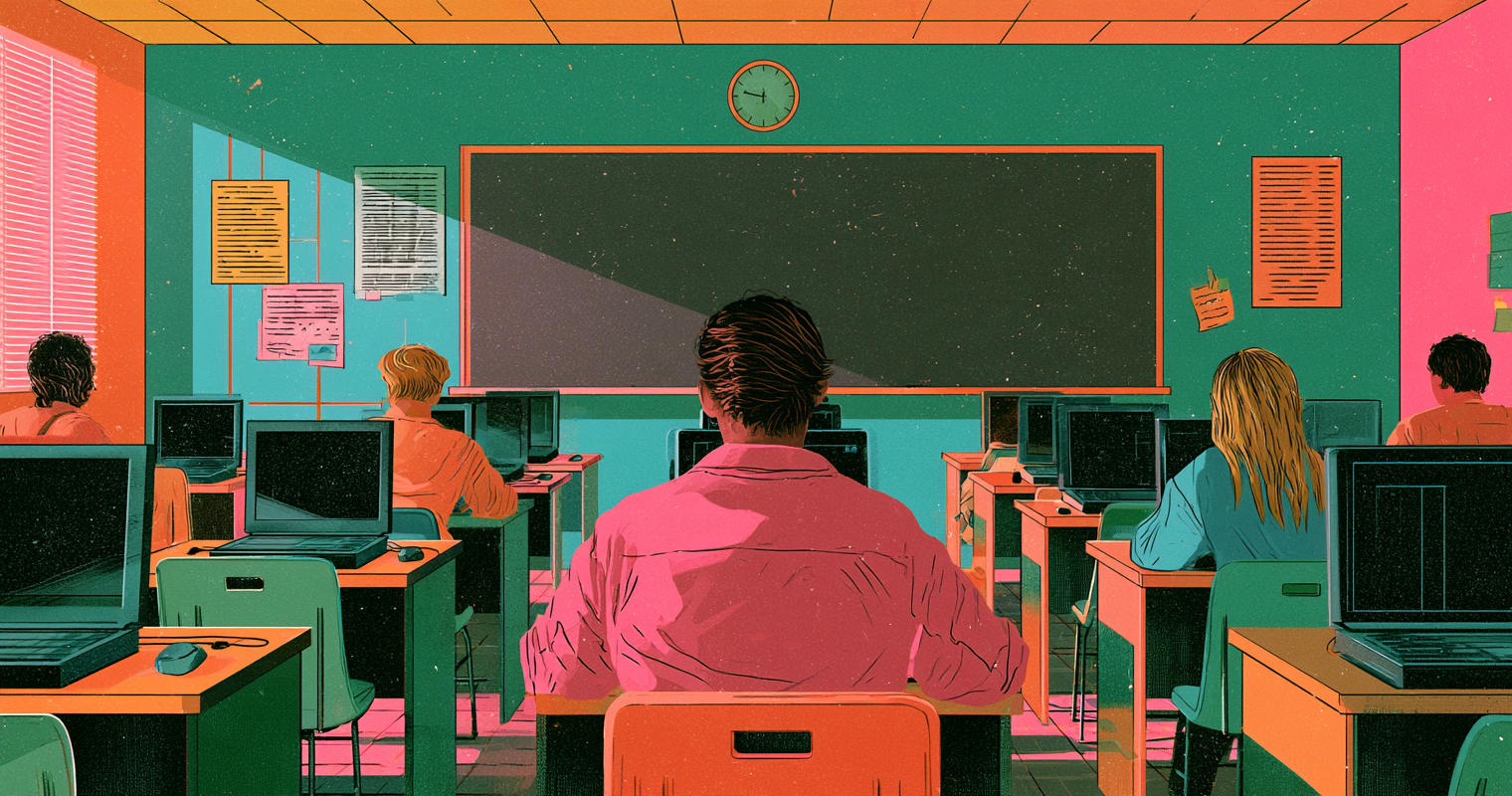
We’ve spent decades arguing about access to education — who gets in, who pays, who’s kept out. It’s an important argument and I don’t want to ignore it. But it quietly assumes the thing you’re getting access to is fine, and the only problem is the queue outside the door. What if the room itself is built for one kind of person, and a good number of the people we let in were never going to fit it?
That’s the question I can’t put down, and I’ll declare up front that it’s a personal question. Some of the traits our education system is worst at accommodating — needing structure, thinking in patterns, deep focus on one thing to the exclusion of almost everything else, needing to pull something apart and put it back together, a real discomfort with ambiguous social performance — are traits I recognise in myself, and they’re the ones I’ve built a forty-year career on. I’ve done enough of the questionnaires to know I’m not neurotypical, whatever the precise label. So read what follows knowing I have a dog in this fight. I’ve tried to argue it on the evidence anyway.
The system telling on itself
Let’s start with a number that should stop a conversation.
Complaints to the Office of the Independent Adjudicator — the body students escalate to when their university has failed them — hit a record 3,613 in 2024, up 15% in a single year, the biggest jump in a decade. That alone tells you something is straining. But here’s the figure that lodged in me: 40% of the students who complained reported having additional needs.
Now, I have to be honest about what that number is and isn’t, because I don’t respect an argument that inflates its own evidence. Those 3,613 people are a self-selected group — they’re the ones who’d already fallen out with their institution badly enough to escalate a formal dispute. It doesn’t prove the teaching model caused their grievance. You can’t build a whole case on complainants.
But you don’t have to, because it points the same way as harder evidence. The Office for Students finds that disabled students report worse experiences than their peers across every single theme of the National Student Survey. Not one or two. Every one. And in one large survey, only 38% of disabled students felt they got the support and adjustments they needed to study on equal terms. So the complaint figure isn’t the argument — it’s the loud symptom sitting on top of a quieter, more rigorous finding. The system works less well for these students at basically every point of contact, and when it fails badly enough, they’re the ones disproportionately hammering on the door marked “complaints.” That’s not a footnote. That’s the system telling on itself.
One caveat before I go further. The hard numbers here — the complaints, the survey data — are about disabled students, a much bigger and more varied group than the neurodivergent minority I’ve been describing. I don’t want to quietly treat them as the same thing. But the overlap is real, and so is the deeper point they share: the “disability” in the Equality Act is defined partly by whether the environment disables you. A system built for one profile is, quite literally, what turns a difference into a disadvantage. So I’ll use the broad data for the broad claim — the system serves this whole population worse — and keep the narrower neurodivergence argument to where I can actually stand it up.
The monoculture in the lecture hall
Here’s what makes it worse: we know the dominant teaching model is weak for everyone, and we’ve known for years.
Most of the sector still runs on a format a student from 1965 would recognise on sight — lecture, seminar, exam, repeat. The landmark meta-analysis of undergraduate STEM teaching found that active learning — actually doing something with the material rather than being talked at — raised performance and cut failure rates substantially against straight lecturing. It’s one of the personal bits I mentioned above. I was often the kid staring out the window in a Physics lesson thinking about taking apart the old TV in the garage at home to figure out what all the components did. The mass passive lecture is one of the least effective ways an adult learns anything. And students are quietly voting on it: HEPI’s twenty-year study found scheduled-class attendance has fallen from 63% in 2006 to under half by 2025.
I’ll be fair — that attendance drop has many causes, part-time jobs and recorded lectures and long commutes among them, and I won’t claim it proves teaching got worse. But sit the two findings side by side and the picture is hard to unsee. We are delivering a format the evidence questions, in a single dominant mode, to a population we now know is far more cognitively varied than we admitted even a decade ago.
If the standard method already underperforms for the typical student, imagine being the one for whom the standard method is actively the wrong shape — who needs to read it rather than hear it, or build it rather than read it, or have the ambiguity stripped out before it means anything at all. We didn’t design them out on purpose. We just designed for an average, and then treated everyone who deviates from the average as their problem to solve rather than ours.
The trap I want to avoid
Now, here’s where a lazy version of this argument goes wrong, and I want to step around it deliberately, because if I don’t, someone who’s read the research will rightly stop trusting me.
The intuitive fix is: match the teaching to each person’s “learning style.” Visual learners get pictures, auditory learners get audio, and everyone thrives. It’s neat, it’s popular, and it’s wrong — or at least, there’s no good evidence it works. The most-cited review of the field (Pashler and colleagues) went looking for the effect and found “no adequate evidence base” for the idea that matching instruction to a stated learning style helps anyone. So I’m not arguing that we should type every child as a “visual learner” and teach them in their supposed channel. That’s a myth wearing a lab coat.
The real point is different, and sturdier. It isn’t that each person has one fixed style you must cater to. It’s that teaching in a single mode, badly, serves almost no one — and genuine variety, built on methods that actually have evidence behind them, serves far more people than the monoculture does. Presenting material in more than one representation at once — words and visuals, or words and audio — has real support (the multimedia and modality effects are among the better-evidenced findings in the field). Teaching students how to manage their own learning — metacognition, self-regulation — is one of the highest-impact, most teachable interventions we have. None of that requires the learning-styles fairy tale. It just requires us to stop pretending the 1965 lecture is the natural and only form knowledge can take.
The distinction matters because it’s the difference between a slogan and a strategy. “Everyone learns differently, so match their style” is a slogan, and a debunked one. “Our single default mode is weak, so build variety and choice on evidence-based foundations” is a strategy — and it happens to catch a lot of the people the current system grinds up.
Why I won’t romanticise it
There’s a seductive story doing the rounds that I need to hold at arm’s length, even though it flatters people like me. It goes: neurodivergent minds are secretly better — the pattern-spotters, the deep-focusers, the rule-breakers are the hidden founders and innovators, and school just fails to see their genius. At school, I was described as “smart” or “brilliant”, but also “lazy” and “inattentive”. And I carried those descriptions for a long time.
But I don’t buy the unrecognised genius trope, or at least not in that shape. Sure, a neurodivergent mind can often do some things spectacularly well, but will trip over itself on others. Neurodivergence is hugely varied — it isn’t one thing, and it doesn’t come with a bonus superpower stapled to it. For plenty of people it brings real, grinding difficulty and no compensating party trick, and turning it into a founder-origin myth is its own kind of dishonesty. I’ve watched too many talented people be quietly worn down by environments that could have accommodated them, to pretend the difficulty is secretly a gift.
So the claim I’ll actually defend is narrower and, I think, harder to argue with: we penalise minds we could just as easily be accommodating, and then act surprised at what we’ve lost. Not “these minds are superior.” Just — they’re capable, they’re numerous, and the cost of building the whole system for one cognitive profile is a stream of capable people falling out the bottom for reasons that have nothing to do with their ability. The waste isn’t romantic. It’s just waste.
And it connects to something I believe about innovation generally: homogeneous environments produce homogeneous answers. A system that only really works for one kind of mind doesn’t just fail the people it excludes — it makes itself narrower, less surprising, less capable of the odd, sideways thinking that actually moves things forward. I spent a career encouraging the often quiet, excluded voices. That’s where the breakthrough ideas came from, not from the linear group think. Inclusion here isn’t a kindness bolted on the side. It’s the mechanism.
Where I land
The thread running under all of it is the one I keep coming back to in everything I write: education is broken because it’s built around the convenience of institutions rather than the experience of the learner. The single lecture format is convenient for the institution. One assessment mode is convenient. One implicit cognitive profile — sit still, absorb passively, perform fluently under social pressure, hand it back in an exam — is convenient. The learner is the variable everyone’s happy to flex.
The fix isn’t a heroic reinvention. It’s more modest and more honest than that: stop treating the standard mould as neutral, build genuine pedagogical variety and choice on methods that have evidence behind them, and measure how the system serves the people who don’t fit the average — not just the ones who do. When 40% of your formal complaints and the worse-on-every-measure survey data are both pointing at the same group, that’s not a run of bad luck. That’s a design telling you who it was drawn for.
We could accommodate these minds. We mostly choose not to, because the current shape is cheaper and easier to run. And then we call the people it fails a problem, when the honest word is cost — a cost we’ve decided, mostly without noticing, to keep paying.
Why I should mention Desk2Educate
You should know I don’t write this from the stands. As well as my personal experience in education as both a child and adult learner, I’m the CTO of Desk2Educate, and helping build a genuine alternative to the one-size-fits-all model is quite literally the day job — so weigh everything above accordingly.
Let me be precise about how small a slice of this we actually touch, because ending a piece like this with a product pitch is the fastest way to lose the argument. We’re not fixing university pedagogy or rewiring how schools teach. What we’re doing is narrower: opening up entrepreneurship, employability and upskilling education to people who don’t usually get a fair shot at it, and trying to build it the way I’ve just argued education should be built — less rigid course marched through in lockstep, more personalised and non-linear, something that adapts to the learner instead of demanding the learner contort themselves around an institution’s timetable and its single default mode.
That’s the whole thesis of this piece turned into a product, which is exactly why you should be sceptical when I say it works. I would say that, wouldn’t I. So take the argument on its evidence — the OfS data, the complaint figures, the active-learning research, the learning-styles caution — none of which I own and all of which was true before I had a stake in the outcome. Desk2Educate is one answer, for one group of people, and a deliberately modest one (for now!). The case that we’ve built the system for one kind of mind, and quietly paid for it ever since, doesn’t rest on my experience and current mission. It rests on the evidence. Working on Desk2Educate is just what I decided to do about it.